
Mineral County Court Records After Arrest
A Mineral County arrest record and a Mineral County court record answer different questions. The arrest and booking side shows why a person entered custody, where the person was held, and whether the person was released, transferred, or still in jail. The court side shows the case number, filed charge, hearing path, bond order, warrant history if it is part of the case, disposition, and sentence. That distinction matters in Mineral County because no official Mineral County online jail roster, booking report, or mugshot gallery was found in the official research. The available route is narrower and more records-based.
Mineral County criminal cases are handled in the 12th Judicial District through Mineral Combined Court. The Colorado Judicial Branch lists the court at 1201 North Main, P.O. Box 337, Creede, CO 81130, with weekday courthouse hours of 9:00 a.m. to 4:00 p.m. The 12th Judicial District Attorney's Office serves Mineral County and is led by District Attorney Anne E. Kelly. Sheriff Terry Wetherill's office is the local law-enforcement contact for Mineral County arrest routing, but the court record is where filed charges and final results are checked. For custody and booking facts, start with Mineral County jail inmate records. For booking photos, use the separate Mineral County jail mugshots process.
Local records split: Mineral County Sheriff records, Rio Grande County Jail records, Judicial Branch court files, CBI criminal history, CDOC, BOP, and ICE are separate systems. A match in one does not prove the same status in another.
Find Mineral County Court Records
The Colorado Judicial Branch Mineral County page is the official local court starting point. It provides Mineral Combined Court information, docket access, WebEx links, and a records-request path. The Judicial Branch public-records guide also explains an important limit: Colorado court records are not searched directly through the Judicial Branch website as a public case database. Limited online access is available through paid vendors linked by the branch, while official document copies must come from the court or the online records request process.
For a Mineral County court records after arrest search, use the defendant name if the case number is not known. If the booking or bond paper shows a case number, use it because names can be misspelled, abbreviated, or shared by more than one person. A commercial vendor result may show a register of actions, but the Judicial Branch warns that vendor data is not the official record and may omit case types or contain errors. Official copies come from Mineral Combined Court or a Judicial Branch records request.
| Search or Request Field | Type | Required | Use Notes |
|---|---|---|---|
| Name | Paid vendor search field | Varies | Use full legal name and likely spelling variants for the defendant. |
| Case number | Paid vendor search field | Varies | Best field when a docket, bond order, or court notice already lists it. |
| Online records request fields | Judicial Branch request form | Varies | Used for specific court case or person records; the court follows up with next steps. |
The Colorado Judicial Branch access guide for public records is also useful when a case needs official copies instead of a quick name search.
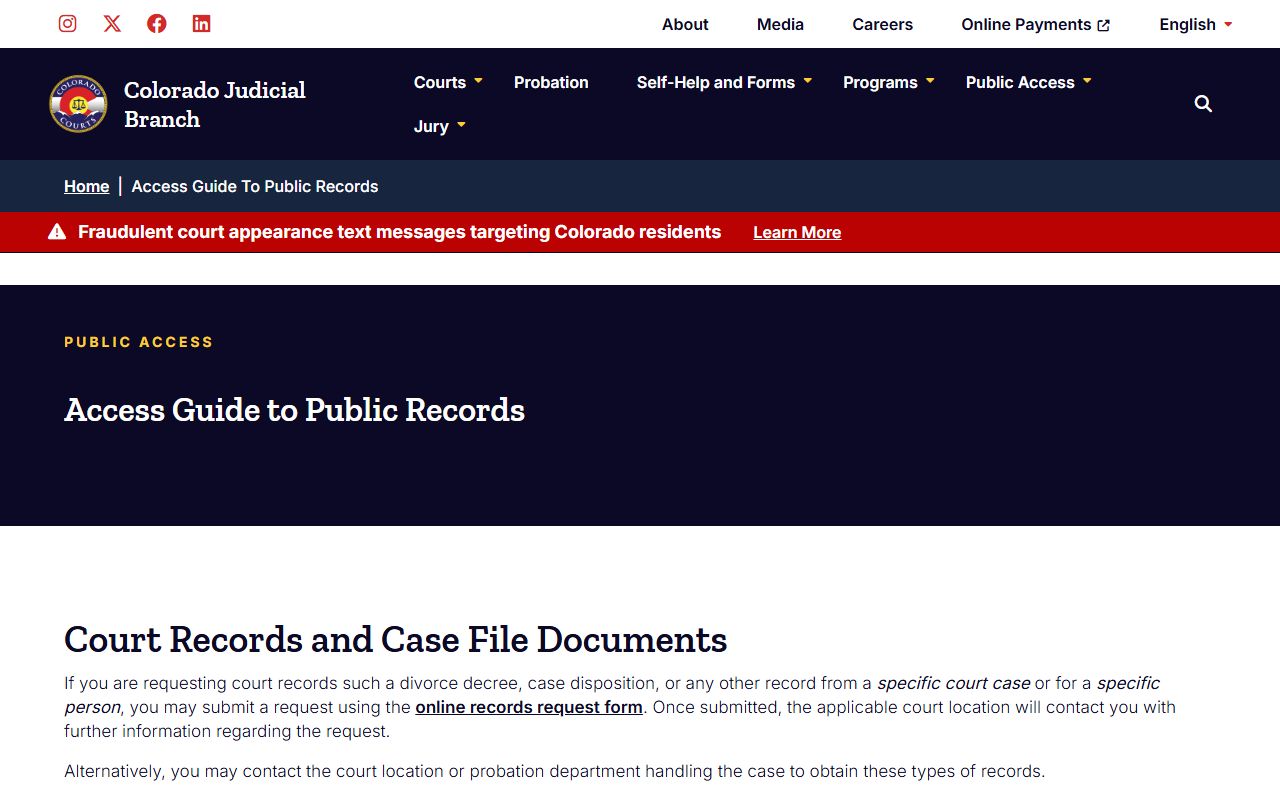
The access guide screenshot fits this page because Mineral County court records after an arrest are verified through court and Judicial Branch channels, not through a county mugshot site.
Arrest to Court Record
The basic path is arrest, booking, advisement, prosecutor review, charging document, court case, disposition. In Mineral County, the booking event may involve Mineral County deputies and the jail-serving Rio Grande County Jail. Official Mineral County payment and board materials tie jail expenses and regional jail coordination to Rio Grande County Sheriff, but the filed criminal case is still a court matter. That means a custody call to Rio Grande County Jail at 719-657-4000 can confirm jail status, while the court case must be checked through Mineral Combined Court or the Judicial Branch process.
- Confirm the person and event. Use the name, date of arrest, arresting agency, and any bond or summons paperwork.
- Check the court side. Search by name or case number through the Judicial Branch vendor route, then request official copies from the court if needed.
- Read the charge list. Compare the arrest charge with the charge actually filed by the prosecutor.
- Check status and next dates. Look for pending, amended, dismissed, sentenced, warrant, or closed status.
- Verify custody separately. A court case may stay open after release, transfer, or a state or federal custody move.
For a local visual reference, the Colorado Judicial Branch Mineral County court page shows the official court location and court-record links used for Mineral County court records after jail arrest research.
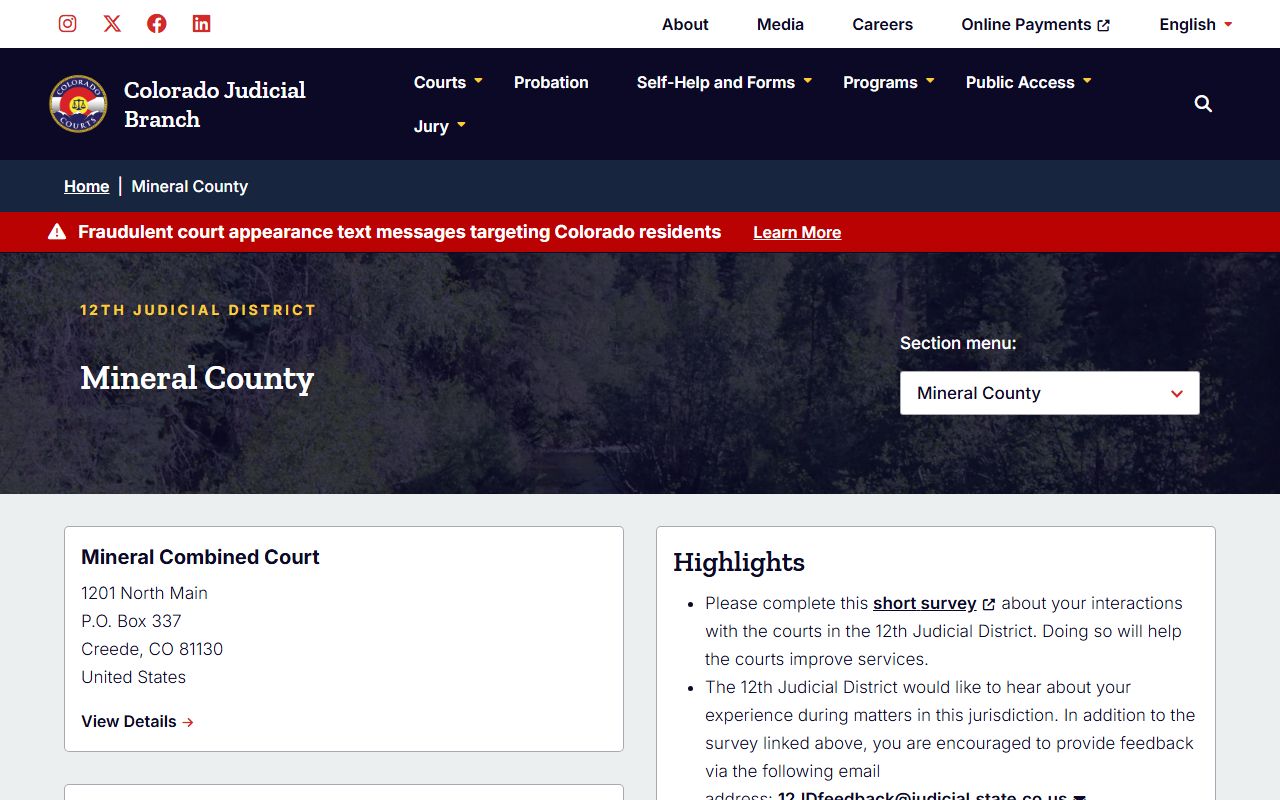
The Judicial Branch court page is the better source for filed charge status than a jail booking entry because court records track the case after prosecutor review.
Mineral County Charging Documents
A charging document is the court paper that states what crime the government claims occurred. It is not the same as the jail's intake entry. Booking charges may be entered quickly after arrest, while filed charges can change after the district attorney reviews reports, witness facts, evidence, and jurisdiction. The 12th Judicial District Attorney's Office serves Mineral County from 601 Main Street, Alamosa, CO 81101, and can prosecute cases for Mineral County in the 12th Judicial District.
| Document | Who Usually Files It | What It Does | What to Check |
|---|---|---|---|
| Complaint | Law enforcement or prosecutor | Starts many criminal cases with stated accusations. | Charge wording, date, agency, and first hearing. |
| Information | Prosecutor | Lists prosecutor-filed charges, often after review. | Whether charges changed from the booking entry. |
| Indictment | Grand jury | Starts a case based on grand-jury action. | Filed counts, defendants named, and court orders. |
Mineral County court records after a jail arrest should be read from the newest filing forward. An older complaint can be amended. A charge can be reduced. A count can be dismissed while another remains pending. The final disposition is the key record for conviction status.
Mineral County Charge Status
Charge status is the case's present legal posture. It can change several times between booking and final sentence. A pending charge is still unresolved. An amended charge has been changed by filing or court action. A dismissed charge is no longer being pursued in that case. A conviction means guilt was found by plea or verdict. These words affect background checks, sealing requests, bond decisions, and how a person explains the court record.
| Status | Plain Meaning | Why It Matters |
|---|---|---|
| Pending | The charge remains open. | Future hearings, bond terms, and warrants may still apply. |
| Amended or reduced | The filed charge changed from an earlier version. | The booking charge may no longer match the court record. |
| Dismissed | The charge was dropped in the case. | It is not a conviction, though the arrest may still have records. |
| Convicted | A plea or verdict produced a finding of guilt. | Sentencing, probation, jail, or CDOC issues may follow. |
| Warrant | The court issued an order tied to the case. | A missed hearing or hold can lead to arrest or continued custody. |
Use the court status for legal outcome. Use the jail or sheriff for custody. Use the Colorado Bureau of Investigation Internet Criminal History Check for a separate Colorado criminal-history search, with the limits and fees stated by CBI.
Bond and Warrants After Arrest
Bond is set or reviewed by the court, but jail release is handled through the jail that has custody. Research did not locate Mineral County-specific bond payment methods or a complete Rio Grande County Jail bond page. The confirmed path is to contact Rio Grande County Sheriff at 719-657-4000 for jail release questions, Mineral County Sheriff at 719-658-2600 for local arrest routing during office hours, and Alamosa Dispatch at 719-589-5807 for after-hours non-emergency law-enforcement routing.
| Bond or Hold | How It Works |
|---|---|
| Cash bond | Money is paid to secure release under court-set conditions. |
| Surety bond | A licensed bail agent posts bond under a surety agreement. |
| PR bond | Personal-recognizance release is based on a promise to appear and follow conditions. |
| No-bond hold | Release is not available unless the court changes the hold. |
| Detainer | Another agency may keep a person in custody even after local bond is addressed. |
No official Mineral County public active-warrant search was located. A bench warrant tied to a missed court date may appear in a case record or require direct court or sheriff contact. A warrant arrest can lead to booking, but the warrant's source may be Mineral Combined Court, another county, state parole, a federal agency, or another court.
Charges Convictions Sealed Expunged
Four record terms are often confused after a Mineral County arrest. A charge is an accusation. A conviction is a final guilt result. A sealed record is generally hidden from ordinary public access after a court order. Expungement is a more complete clearing remedy used in narrower contexts. Colorado eligibility depends on record type, disposition, time, and the statute that applies. Court staff can provide record access information, but legal advice should come from an attorney.
| Comparison | First Term | Second Term | Main Difference |
|---|---|---|---|
| Charge vs conviction | Charge: an allegation filed in court. | Conviction: guilt by plea or verdict. | A pending or dismissed charge is not proof of conviction. |
| Sealed vs expunged | Sealed: blocked from general public view. | Expunged: treated as cleared in a stronger way where allowed. | Both require legal eligibility and proper court process. |
Background-check caution: Mineral County court records, CBI results, and commercial vendor data are different sources. Verify official results before relying on any record for a serious decision.
Mineral County Records Law
Colorado open-records law separates general public records from criminal justice records. CORA, C.R.S. 24-72-201 to 206, covers public records generally. C.R.S. 24-72-203 gives a usual three-working-day response period, with a possible seven-working-day extension for extenuating circumstances. Criminal justice records are governed by C.R.S. 24-72-301 et seq., and the Judicial Branch public-access guide cites custodian authority under C.R.S. 24-72-304 and denial authority under C.R.S. 24-72-305 where law, court rule, court order, or public interest requires it.
Mineral County requests must be made in writing on the official Mineral County Public Records Request Form to the proper custodian. The Mineral County Administrator page says CORA requests go through the Administrator's office, and the Mineral County Sheriff's forms page lists the CORA request form. The county policy says mail and fax are accepted. Email is only accepted at the custodian's prerogative, and an email sent to someone other than the custodian is not received until the custodian confirms it. If the record is a Rio Grande County Jail booking record, the request may need to go to Rio Grande County Sheriff rather than Mineral County.
The 12th Judicial District Attorney homepage shows Mineral County in the served-county list and identifies the district attorney office involved in prosecutor review.
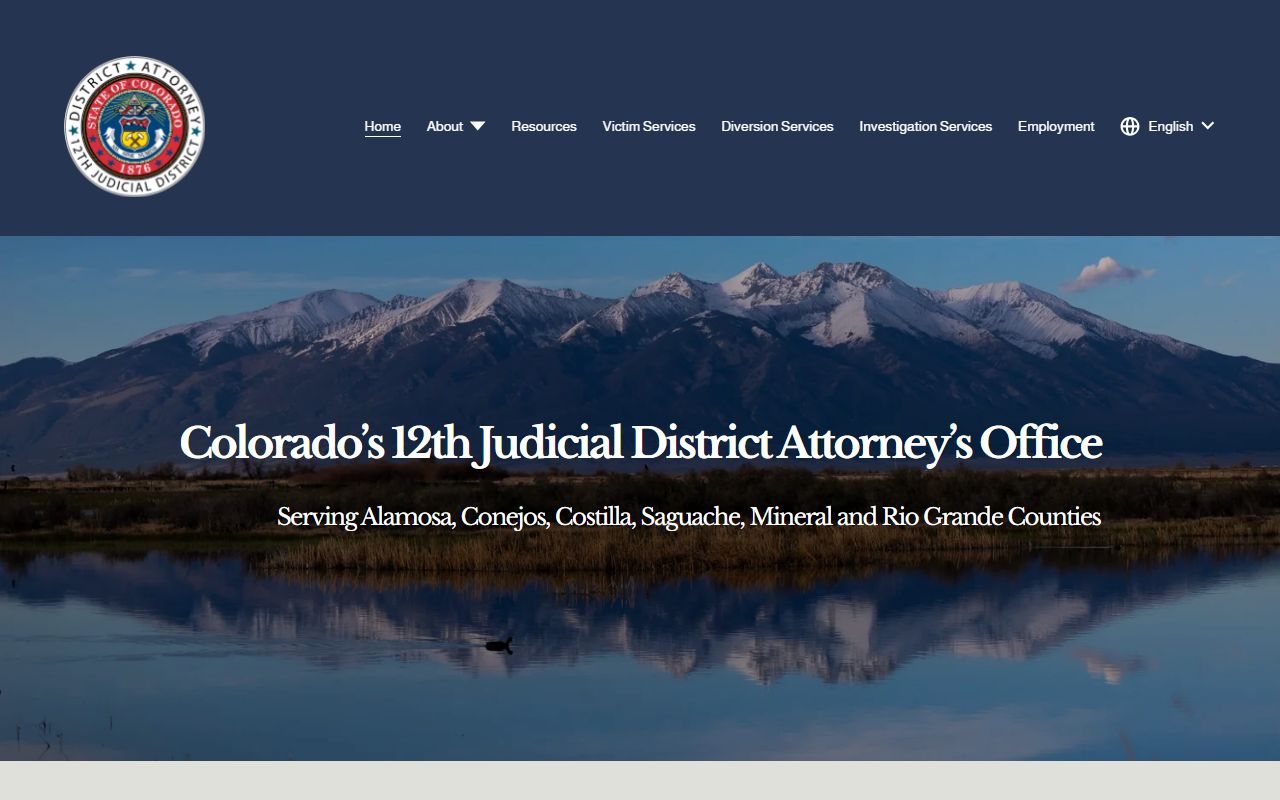
That prosecutor role explains why filed charges in court records after an arrest may not match the first booking description entered at intake.